
There has been a stellar rise for the Indian markets this far in calendar year 2021 (CY21) with the S&P BSE Sensex surging over 19 per cent. The gain in mid-and small-cap indices on the BSE has been sharper with both these indexes surging around 38 per cent and 54 per cent, respectively during this period. Rampant spread of Covid pandemic's Delta variant and the ensuing lockdown and mobility curbs across India, rising prices key commodities, including crude oil and its impact on inflation, possibility of tightening of policy stance by major global central banks, especially the US Federal Reserve (US Fed) have been some of the key headwinds that the markets successfully negotiated during this period.

The dinner Jill Biden and her husband US President Joe Biden hosted for Indian prime minister Narendra Modi, June 22, at the White House brought together, Indians and Americans from so many firmaments.

Due to default in payment, the securities of FICL and NDIL will be valued at zero basis AMFI standard hair cut matrix, and interest accrued and due will be fully provided.

The Income-Tax (I-T) Department nowadays provides pre-filled forms to make the filing of income-tax return (ITR) easier. Nonetheless, you must have a number of documents handy at the time of filing return so that you can cross-check the data in the pre-filled form. "Filing ITR doesn't require you to upload any document. But in case an assessing officer makes an inquiry, you will need to present documents and certificates as proof," says Deepak Jain, chief executive, TaxManager.in.

'Kalnirnay is like a bible for any family.'

In the start-up world, hitting the $1-billion mark, which accords the "Unicorn" tag, is a milestone. Enterprises typically reach the milestone only by series C or series D, or three to four funding rounds later. Zeta achieved it at the first one. On May 25, the six-year-old banking tech firm raised $250 million from Japanese conglomerate SoftBank, at a post-money valuation of $1.45 billion. "This is the first time we have raised institutional money," Zeta co-founder Bhavin Turakhia beamed on the conference call. This trajectory is uncommon in start-ups.

The recent Reserve Bank of India (RBI) norms on tokenisation services, which will be offered by card networks, are likely to result in merchants and payment aggregators incurring a cost as they have to pay a fee to the networks. The merchants and the payment aggregators, in turn, may pass on the cost to the customers. The norms, which were issued by the banking regulator released on September 7, allow card networks like Visa and Mastercard to offer the tokenisation service.

As it readies for its initial public offering (IPO) later this year, digital payments firm Paytm is honing its strengths to remodel itself from being a payment wallet to becoming a financial services provider, and is working towards narrowing its losses, evident from its most recent Annual Report. Unlike many of its peers, Paytm has started expanding its merchant payment ecosystem. It has realised that though it can take the maximum share of the Unified Payment Interface (UPI) transactions, from a revenue generation point of view it will not have any impact.

As lobbying and counter-lobbying intensify, right now, it looks like a T20 match, discovers Tamal Bandyopadhyay.
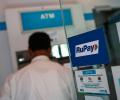
RuPay National Common Mobility Card's offline wallet can be used to make ticket payments in transit, including in metros, cabs, etc, enabling automatic, quick, cashless payments.

The asset quality of non-banking financial companies (NBFCs) deteriorated in April-September 2021 (H1FY22) owing to the second wave of the pandemic. Their gross non-performing assets (NPAs) rose to 6.8 per cent in September 2021 from 6 per cent in March 2021. The Reserve Bank of India's (RBI's) annual Trend and Progress report (FY21) said the sector might have to grapple with higher delinquencies as and when policy measures unwound. The pandemic posed significant challenges to NBFCs during the first wave (2020) also.

Digital payments provider Paytm is all set to make its market debut as early as this year, with an aim to raise $3 billion (around Rs 22,000 crore). If successful, this could be the biggest initial public offering (IPO) by an Indian company, breaking Coal India's 2010 record of Rs 15,475 crore. According to media reports, the board of One97, parent company of Paytm, is all set to meet this Friday to formally approve the IPO plan.

'Domestic will remain very much the core of what IndiGo is.' 'But the emphasis in our next growth phase is going to be on the international side.'

'The fiscal pressure will be there, but the intent of the government behind this move is to spur demand and growth.'

Infrastructure funds, which bet on stocks closely linked with infrastructure development in the country, have emerged as one of the best-performing categories over the past year. They have generated an average return of 90.63 per cent - the third-best, after technology funds and small-cap funds. Of the 21 schemes in the category, seven have given a return of more than 100 per cent in a year.

Transiting from "survival mode", which took most of the management time in FY21, the bank has been able to take a long-term view in terms of growth and preparing technology in the past 12 months.
The Reserve Bank of India (RBI) recently said no entity in the card transaction or payment chain, apart from the card issuers and card networks, will be allowed to store sensitive user data from January 1, 2022. Instead, in transactions card data will be converted to tokens.

'What I have learnt over time is that when it comes to doing any movie, your experiences helps a lot.'
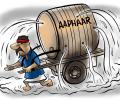
'Every Indian citizen is already exposed to massive digital surveillance and most are already vulnerable to data theft and cyber-impersonation as well,' points out Devangshu Datta.

If bank and service provider are not compliant, pay manually, or give standing instruction linked to bank a/c, suggests Bindisha Sarang.

The newly-appointed chairman of State Bank of India (SBI) Dinesh Khara on Wednesday said maintaining quality loan book, safety of employees and customers will remain his top most priorities. Khara, who took charge on Wednesday, said the bank will continue to strive for even better customer experience.

Operating margins for some companies dipped in Q3, 2021-22 but this sector could be nearing the bottom of the cycle in terms of profits.
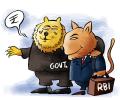
The government plans to bring down its stake to 26 per cent in these two banks, which are yet to be identified. This may not come in the way of getting investors for these banks, provided the government is willing to step back rather than run them the way it had been doing for over five decades since these banks were nationalised, points out Tamal Bandyopadhyay.

While the government has infused huge capital into PSBs, the same has largely been used to mitigate losses and has failed to contribute meaningfully to credit growth.
With the Reserve Bank of India's (RBI) extended deadline coming to an end, there will be no automatic recurring payment for various services including recharge and utility bill as the additional factor of authentication (AFA) will become mandatory from Friday. On December 4, RBI had directed all banks including RRBs, NBFCs, and payment gateways that the processing of recurring transactions (domestic or cross-border) using cards or Prepaid Payment Instruments (PPIs) or Unified Payments Interface (UPI) under arrangements/practices not compliant with AFA would not be continued beyond March 31, 2021. As part of risk mitigation measures, RBI announced this step to bolster safety and security of card transactions.

Almost all banks that issue contactless cards provide users with a 100 per cent liability cover.

The last few months have been hard on digital wallets which had a short-lived dream run post-demonetisation.
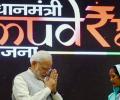
Not only has the Mudra loan mela generated no jobs, it has frittered away trillions of taxpayers' money and it's time to bury the scheme, argues Debashis Basu.

Ajay Banga, one of the topmost Indian-American corporate leaders, and a strong advocate of India-US relationship, would retire from Mastercard at the end of the year, the global credit card company has said.

As India gets ready to roll out one of the largest vaccine programmes, billionaire Mukesh Ambani on Tuesday said his group is working with authorities to provide technology tools and backbone for mass inoculation against COVID-19. Ambani's telecom venture Jio was rolled out four years back, offering free voice calling and dirt-cheap data. Today, Jio is India's largest telecom operator with over 400 million users, each connected to the internet. At a Facebook event, Ambani said the government's digital push kept the country running even during the pandemic and is now helping in the rollout of one of the largest vaccination programmes.

Experts at coding, Web development, and digital marketing, will be on every organisation's hiring list, points out Narayan Mahadevan.

The government is planning to extend the electronic modes of tax payment to its own payments platform, Unified Payments Interface (UPI), credit cards of banks, or even a mobile wallet like Paytm.

Since its launch in April, helpline 155260 has been able to prevent more than Rs 18.5 million of defrauded money from reaching the hands of fraudsters.

'For all of us at Amazon, it is 'Bharat first'.' 'We are keeping the Indian customer at the centre of what we are doing.'

Their skiing adventure is trending on the Internet right now!
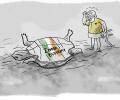
S&P Global Ratings on Wednesday said the second wave of COVID infections poses downside risks to India's GDP and heightens the possibility of business disruptions. The second wave brings in uncertainty and a drawn-out COVID outbreak will impede India's recovery, it said.

Now, 83 per cent males and 77 per cent females have formal bank accounts but they are hardly using them

'Wherever in the world there is political instability, those countries are beset with severe crises today. But India is in a much better position than the rest of the world due to the decisions taken by my government in the national interest,' President Droupadi Murmu said in her address to both Houses of Parliament.

'Yogi was there, but ultimately the BJP got extremely worried and therefore Modi pitched in.'

Your promise to protect bankers for their commercial decisions is a huge confidence booster, but how does one define a commercial decision? Are our investigative agencies well equipped to dissect lending decisions of bankers?
